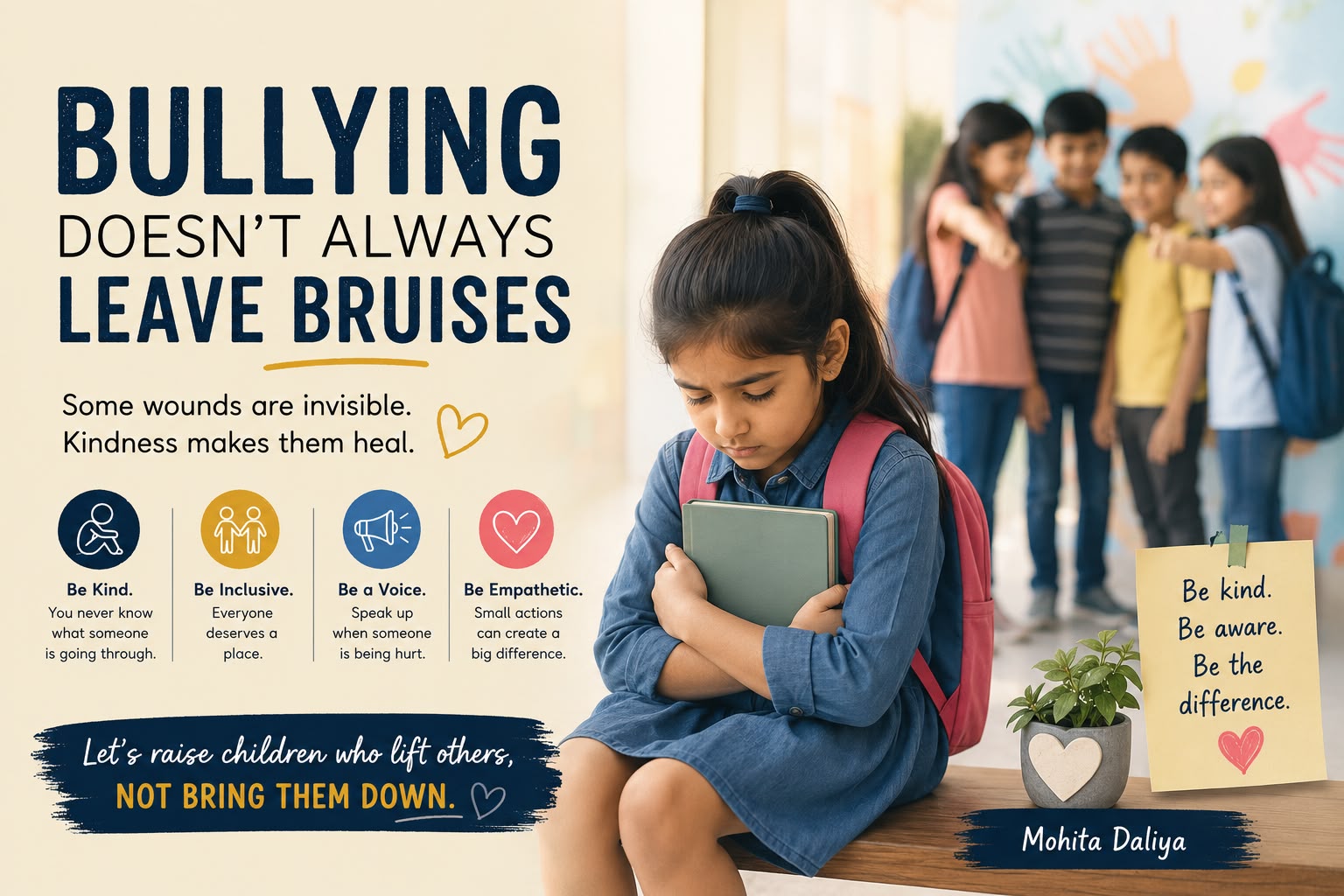
Bullying Doesn't Always Leave Bruises
Not every child who is hurting cries. Not every child who is hurting speaks. And sometimes, not every child who hurts others realizes the impact of their actions.
As parents, we spend so much time worrying about our children's marks, homework, competitions, and screen time. But there is another issue that deserves just as much attention—bullying.
Whenever a tragic incident involving a child makes the news, many parents immediately ask, "Could this happen to my child?" That's an important question.
But there is another question we should have the courage to ask:
"Could my child be making someone else's life difficult?"
Both questions matter.
What is bullying?
Bullying is not a one-time disagreement or a normal argument between children.
Bullying is repeated, intentional behaviour that hurts, humiliates, intimidates, or isolates another child, especially when there is an imbalance of power. It can happen in school, on the playground, in the school bus, during activities, or online.
Bullying can take many forms:
Physical bullying
Verbal bullying
Social bullying
Cyberbullying
The common thread is simple: the behaviour is repeated, intentional, and causes harm.
What is NOT bullying?
Not every disagreement or act of not playing together is bullying.
Children are allowed to choose their friends. A child saying, "I don't want to play right now," or preferring to play with someone else on a particular day is a normal part of growing up.
Similarly, two children arguing over a toy, disagreeing during a game, or having a fight that is resolved does not automatically become bullying.
However, it becomes bullying when the same child is repeatedly targeted.
Imagine a group of children who deliberately refuse to let one child join every day, laugh when that child walks away, encourage others not to speak to them, or constantly make fun of them. That repeated pattern of exclusion and humiliation can be bullying.
A simple way to think about it is to ask:
Understanding this difference is important. If we label every conflict as bullying, we may create unnecessary fear. But if we dismiss repeated exclusion or humiliation as "just kids being kids," we may overlook a child who genuinely needs help.
The wounds we cannot see
The deepest wounds are often invisible.
A child who once loved school may suddenly complain of stomach aches every morning.
A cheerful child may become unusually quiet.
Grades may drop.
Sleep may be disturbed.
A child may stop talking about friends altogether.
Some children become angry. Others become withdrawn. Many simply learn to hide their pain.
One of the saddest realities is that many children never tell their parents what they are going through.
Some fear they won't be believed.
Some think telling someone will make things worse.
Some begin believing that they deserve the treatment they receive.
That is why adults must pay attention to changes in behaviour—not just words.
Conversations matter more than lectures
Instead of asking only,
"How were your marks today?"
also ask,
Sometimes these simple questions open doors to conversations children were afraid to begin.
But what if the bully is our own child?
This is probably the hardest part for any parent to accept.
Most of us naturally imagine our child as the victim.
Very few of us pause to consider that our child could sometimes be the one hurting another child.
This doesn't mean they are a bad child.
Children sometimes bully because they want attention, want to fit into a group, copy what others are doing, seek popularity, or simply don't understand the impact of their behaviour.
That is exactly why they need guidance.
If a teacher or another parent tells you that your child has bullied someone, resist the urge to immediately say,
"My child would never do that."
Instead, listen carefully.
Understand what happened.
Speak to your child calmly.
Help them understand the consequences of their actions.
Correcting behaviour is far more valuable than defending it.
Ask different questions
Before asking your child,
"Did anyone bully you today?"
also ask,
These questions are just as important.
Sometimes children don't realize that repeatedly excluding someone, laughing when another child is embarrassed, or joining the crowd because "everyone else was doing it" can deeply hurt another person.
Teach them that kindness is not just about avoiding bad behaviour.
It is also about choosing to include.
Choosing to speak up.
Choosing empathy over popularity.
The responsibility belongs to all of us
Schools must create environments where every child feels safe.
Teachers should take concerns seriously and intervene early.
Parents should listen without judgement.
And children should know that asking for help is a sign of courage, not weakness.
Bullying is not solved by blaming one side.
It is prevented when families and schools work together.
A message to every parent
We all hope our child is treated with kindness.
Let us also make sure our child treats others with kindness.
Because every child deserves to walk into school feeling safe, respected, included, and valued.
Every child deserves to come home with stories of learning—not fear.
And every parent should remember this:
Sometimes the child who needs protection is yours.
Sometimes the child who needs guidance is yours too.
Let's raise children who are not only confident and successful, but also compassionate, respectful, and brave enough to stand up for what is right.
Because in the end, kindness is one lesson that will matter far beyond the classroom.


Comments
Post a Comment